
Demonstration Francis Turbine
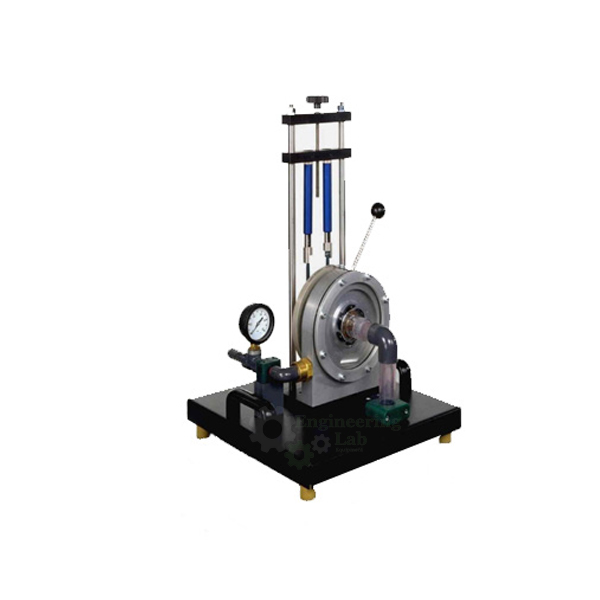
Product Code : EL-FMLE-10655
QUICK ANSWER: The Demonstration Francis Turbine is a self-contained model of a Francis (reaction-type) turbine used to demonstrate turbine design, function and performance testing, with an 11-blade rotor of 60mm medium diameter, an adjustable 7-vane distributor (0…20° angle of attack) and a transparent housing that lets students observe the water flow, wheel and guide vanes during operation. It delivers an output of approx. 350W at 1500min-1 (270L/min, H=15m) up to a max. speed of 3000min-1, with torque determined by a band brake and read on spring balances (measuring range 0…9,81Nm), pressure measured up to 0…4bar abs., and speed measured up to 0…4000min by a non-contact speed sensor, while a manometer shows the water pressure at the turbine inlet. The unit is used for determining torque, power and efficiency, graphically representing characteristic curves, investigating the influence of guide vane position on power output, and studying velocity triangles.
The experimental unit consists of the Francis wheel, the control device with adjustable guide vanes, a band brake for loading the turbine and a housing with a transparent front panel, and the transparent cover enables you to observe the water flow, the wheel and the guide vanes during operation. Operating Principle of a Francis Turbine: the model of a Francis turbine demonstrates the function of a reaction turbine, in which adjusting the guide vanes modifies the angle of incidence and thus the speed of the impeller. Water turbines are turbo machines utilizing waterpower, and the Francis turbine is part of the reaction turbines, which convert the pressure energy of the water into kinetic energy in the control device and in the impeller.
The water is fed in the control device by means of a spiral housing, and the flowing water is accelerated in the control device by the adjustable guide vanes and directed onto the vanes of the impeller. The redirection and further acceleration of the water in the impeller generates an impulse, which is transmitted to the Francis wheel. The turbine torque is determined by force measurement on a band brake and is read on spring balances. For measuring the rotational speed, a non-contact speed sensor is used, and a manometer shows the water pressure at the turbine inlet.
FEATURES:
Design and function of a Francis turbine
Determination of torque, power and efficiency
Graphical representation of characteristic curves for torque, power and efficiency
Determination of mechanical output
Determination of efficiency
Recording of characteristic curves
Investigation of the influence of the guide vane position on the power output
Velocity triangles
SPECIFICATION:
Turbine:
Output: approx. 350W at 1500min-1, 270L/min, H=15m
Max. Speed: 3000min-1
Rotor:
11 blades
Medium diameter: 60mm
Measuring ranges:
Torque: 0…9,81Nm
Pressure: 0…4bar abs.
Speed: 0…4000min
Distributor:
7 vanes
Angle of attack: 0…20°
DIMENSIONS AND WEIGHT:
L x W x H: 1000 x 800 x 1200 mm
Weight: 90kg
For this and other fluid mechanics lab equipment, schools and colleges can contact Engineering Lab Equipment, a manufacturer, supplier and exporter based in Ambala, India.
Last Updated: September 2026Related Products: Demonstration Pelton Turbine, Propeller Turbine, Hydraulic Ram Test Bed, Energy Losses in Pipes


