
Pascal Apparatus
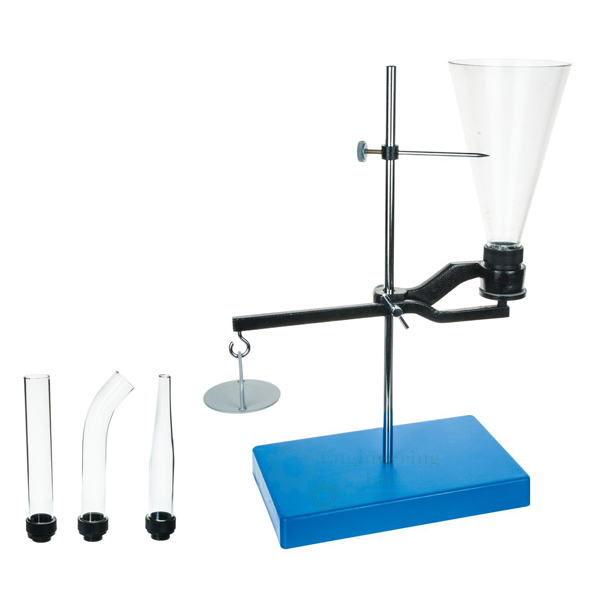
Product Code : EL-FMLE-10673
Pascal Apparatus (code EL-FMLE-10673) is used to demonstrate that the pressure at the base of a liquid column depends only on its depth and the nature of the liquid, not on the size or shape of the vessel. Three 230 mm high glass vessels with the same 26 mm base diameter, one straight, one conical widening to 80 mm and one inverted conical narrowing to 10 mm, fit in turn onto a membrane that presses on a lever arm balanced with masses and a spirit level.
Get a quote: use the Add To Cart enquiry button below, or send your quantity and delivery location through the contact page.
Specifications
| Parameter | Detail |
|---|---|
| Use | Demonstrating Pascal's principle; determining hydrostatic pressure and the linear relation between pressure and filling height |
| Principle shown | Pressure in an incompressible fluid depends only on its head (liquid level) and the nature of the liquid, not on the size of the column section |
| Vessels | Three glass vessels, 230 mm high, with the same base diameter and different shapes |
| Straight vessel | Internal diameter 26 mm |
| Conical vessel | Internal diameter from 26 mm to 80 mm |
| Inverted conical vessel | Internal diameter from 26 mm to 10 mm |
| Vessel mounting | Leak proof metallic collars on a metal base; support for the vessel and membrane |
| Force transfer | Body with a diaphragm (membrane) to which any vessel is attached; the membrane transfers the force to a lever arm |
| Balance | Lever arm and spirit level to measure the weight at the base of the vessel; masses set |
| Level setting | Vertical rod with a height-adjustable pointer (portable indicator) to fix the water level in the vessels |
| Levelling | Fastening nut |
| Frame | Anodized aluminium profile frame and painted steel panel |
| Dimensions and weight | |
| L × W × H | 600 × 500 × 600 mm |
| Weight | 40 kg |
| Supply | |
| Product code | EL-FMLE-10673 |
| Manufacturer | Engineering Lab Equipment, Ambala, Haryana, India |
What Is the Pascal Apparatus Used For?
Pascal's principle explains why a narrow column of liquid presses as hard on its base as a wide one of the same depth: the pressure depends on depth and density alone, and the shape of the container makes no difference. Students fit one vessel to the membrane, set the pointer to the chosen level, fill to the pointer and add masses until the lever arm is level on the spirit level. Exchanging the straight vessel for the conical and inverted conical ones at the same level gives the same balancing mass, and repeating at several filling heights shows that pressure rises in a straight line with depth.
What to Specify When Ordering
- Quantity — the number of Pascal apparatus required.
Frequently Asked Questions
What does the Pascal Apparatus demonstrate?
It shows that the pressure in an incompressible liquid depends only on its head and on the nature of the liquid, and has no relation to the size or shape of the column.
Which vessels are supplied?
Three glass vessels 230 mm high: a straight vessel of 26 mm internal diameter, a conical vessel widening from 26 mm to 80 mm and an inverted conical vessel narrowing from 26 mm to 10 mm.
How is the force at the base measured?
Each vessel attaches to a body with a diaphragm, which transfers the force of the water to a lever arm. The arm is balanced with a set of masses and checked with a spirit level.
How is the same water level set in every vessel?
A height-adjustable pointer on a vertical rod fixes the water level, so each vessel is filled to the same height and the force on the membrane can be compared directly.
Can the relation between pressure and depth be measured?
Yes. Hydrostatic pressure is determined quantitatively, and repeating the balance at different filling heights gives the linear relation between pressure and the filling head of the vessel.
What are the frame and overall size?
The apparatus is built on an anodized aluminium profile frame with a painted steel panel and a fastening nut for levelling; it measures 600 × 500 × 600 mm and weighs 40 kg.
OEM Manufacturer
Buyers of the Pascal Apparatus deal directly with its maker, Engineering Lab Equipment (Engineering Labs Equipment Pvt Ltd), whose works are at Plot No. 43, Industrial Park, Sector 2, Growth Center, Saha, District Ambala, Haryana, India. The company designs, makes and tests fluid mechanics apparatus for flow measurement, pipe friction, pumps and hydrostatics, supplies engineering colleges, polytechnics, technical training institutes and research laboratories in India and overseas, and builds to institution-specific requirements on request. Tender details are on the Tenders/OEM page.
Related Fluid Mechanics Equipment
- Hydrostatic Pressure Apparatus — quadrant balance on a 5.5 ltr acrylic tank for measuring hydrostatic thrust and centre of pressure.
- Fluid Statics and Manometry — hydrostatics and manometry panel with vertical tank, U tube, inclined tube and Vernier hook and point gauge.
- Fluid Properties and Hydrostatics Bench — trolley-mounted hydrostatics bench with sealed water circuit, manometers, hydrometers, viscometer tubes and Archimedes module.
See the full Fluid Mechanics Lab Equipment range or all Mechanical Engineering Lab Equipment.
Request a Quote
For this and other fluid mechanics lab equipment, schools and colleges can contact Engineering Lab Equipment, a manufacturer, supplier and exporter based in Ambala, India. Quotations are given on request: send the number of Pascal apparatus required and your delivery location through the contact page, or add the Pascal Apparatus to the enquiry cart from this page.
Last updated: October 2026


