
Gear Train Model
Product Code : EL-AMLE-10626
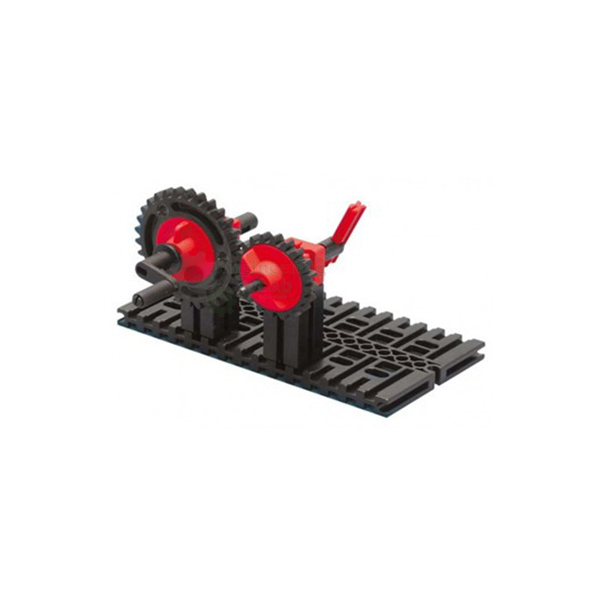
Gear Train Model (code EL-AMLE-10626) is a demonstration model of a differential gear train built entirely from spur gears, used to show how a mechanism with two controllable inputs behaves. It combines two planetary gear trains whose sun gears share a common axis, and holding the right or left wheel fixes the corresponding sun gear while the other gears stay free to rotate.
Get a quote: use the Add To Cart enquiry button below, or send your quantity and delivery location through the contact page.
Specifications
| Parameter | Detail |
|---|---|
| Type | Differential gear train |
| Gears | All spur gears |
| Arrangement | Two planetary gear trains with coaxial sun gears |
| Function | Similar to a standard differential gear train; for situations needing two controllable inputs |
| Operating conditions | |
| Both wheels released | All spur gears run when the mechanism is driven |
| Right wheel held | Right sun gear fixed; other gears still rotatable |
| Left wheel held | Left sun gear fixed; other gears still rotatable |
| Supply | |
| Product code | EL-AMLE-10626 |
| Manufacturer | Engineering Lab Equipment, Ambala, Haryana, India |
What Is the Gear Train Model Used For?
Planetary and differential gear trains let one input be shared between two outputs, or two inputs be combined into one, which is how a vehicle differential allows the driven wheels to turn at different speeds on a bend. The student drives the model first with both wheels free and watches every spur gear turn, then holds the right wheel and the left wheel in turn and follows which gears stop and which keep rotating. Counting turns in each condition shows how fixing one sun gear changes the speed relation between the remaining members.
What to Specify When Ordering
- Quantity — the number of gear train models required.
Frequently Asked Questions
What type of gears does the model use?
Every gear in the model is a spur gear. The gears form a differential gear train made from two planetary gear trains whose two sun gears are coaxial.
What happens when one wheel is held?
Holding the right wheel fixes the right sun gear and holding the left wheel fixes the left sun gear; in both cases the remaining gears can still rotate.
Where is a mechanism like this used?
It suits applications that need two controllable inputs, and its function is similar to that of a standard differential gear train such as the one in a vehicle drive line.
What does the model show with both wheels free?
When the mechanism is driven with both wheels released, all of its spur gears run, showing the whole gear train in motion before either sun gear is fixed.
OEM Manufacturer
The Gear Train Model is made by Engineering Lab Equipment (Engineering Labs Equipment Pvt Ltd) at its works at Plot No. 43, Industrial Park, Sector 2, Growth Center, Saha, District Ambala, Haryana, India. The company designs, makes and tests applied mechanics apparatus for statics, friction, machines and mechanisms for engineering colleges, polytechnics, technical training institutes and research laboratories in India and overseas, and can build equipment to an institution's own requirements. Tender and OEM enquiries are handled through the Tenders/OEM page.
Related Applied Mechanics Equipment
- Gear Trainer Demonstrator — three forward and reverse sliding mesh gearbox model with protractor pulleys for ratio experiments.
- Worm and Wheel Apparatus — wall-bracket worm and wheel with 25 cm machine-cut worm gear, 12 cm drum and effort pulley.
- Four Bar Chain Apparatus — four-bar linkage unit with adjustable pivot joints and input and output angle scales on a base plate.
See the full Applied Mechanics Lab Equipment range or all Mechanical Engineering Lab Equipment.
Request a Quote
For this and other applied mechanics lab equipment, schools and colleges can contact Engineering Lab Equipment, a manufacturer, supplier and exporter based in Ambala, India. To ask for a quotation, send the number of gear train models required and your delivery location through the contact page, or use the Add To Cart enquiry button on this page.
Last updated: October 2026


