
Computerized Stefan Boltzman Apparatus
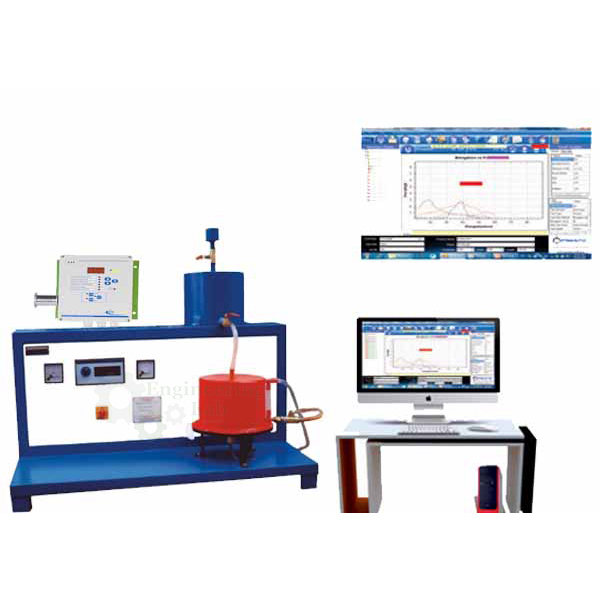
Product Code : EL-HAMTLE-10758
Computerized Stefan Boltzman Apparatus (code EL-HAMTLE-10758) is a heat transfer trainer in which a heated metal cylinder at the centre of an 11 L pressure vessel lets heat transfer by radiation be separated from convection. For radiation tests the vessel is pumped down to approx. 0.02 mbar by a rotary vane pump, while for convection tests in air or other gases compressed air raises it to a positive gauge pressure of up to approx. 1 bar, with readings shown on digital displays and passed to a PC via USB.
Get a quote: use the Add To Cart enquiry button below, or send your quantity and delivery location through the contact page.
Specifications
| Parameter | Detail |
|---|---|
| Use | Matching heat quantities to the type of transfer: radiation, convection and combined |
| Core element | Heated metal cylinder at the centre of the pressure vessel, with controlled surface temperature |
| Temperature measurement | Surface temperature of the metal cylinder and wall temperature of the pressure vessel |
| Vacuum operation | Heat transported mainly by radiation |
| Positive pressure operation | Gas-filled vessel; heat also transferred by convection |
| Gases | Air; nitrogen, helium, carbon dioxide or other gases |
| Vacuum generation | Rotary vane pump, down to approx. 0.02 mbar |
| Positive pressure | Up to approx. 1 bar with compressed air |
| Pressure sensors | Pirani sensor for negative pressure; piezo-resistive sensor for positive pressure |
| Displays and PC | Digital displays; USB transfer to a PC with analysis software |
| Experiments | Radiation in vacuum; radiation coefficient; heat transferred by convection; heat transfer coefficient from measured values and theoretically from the Nusselt number; comparison of gases; heat transport between heating element and vessel wall |
| Vacuum pump | |
| Power consumption | 250 W |
| Nominal suction capacity | 5 m³/h |
| Final pressure with gas ballast | 3 × 10^-3 mbar |
| Final pressure without gas ballast | 3 × 10^-3 mbar |
| Heating element | |
| Output | 20 W |
| Radiation surface area | Approx. 61 cm² |
| Pressure vessel | |
| Pressure | -1 to 1.5 bar |
| Volume | 11 L |
| Measuring ranges | |
| Negative pressure | 0.5 × 10^-3 to 1000 mbar |
| Pressure | -1 to 1.5 bar rel. |
| Temperature | 0–250 °C |
| Power | 0–23 W |
| Requirements, dimensions and weight | |
| Power supply | 230 V, 50 Hz, 1 phase; 230 V, 60 Hz, 1 phase; 120 V, 60 Hz, 1 phase |
| Dimensions (L × W × H) | Approx. 1400 × 800 × 1500 mm |
| Weight | Approx. 130 kg |
| Supply | |
| Product code | EL-HAMTLE-10758 |
| Manufacturer | Engineering Lab Equipment, Ambala, Haryana, India |
What Is the Computerized Stefan Boltzman Apparatus Used For?
A hot body in air loses heat both by radiation and by convection, and the two are hard to separate in an open room. Here the vessel is first evacuated with the rotary vane pump, so almost no gas remains and the heating power needed to hold the cylinder at its set surface temperature is taken by radiation alone; this gives the radiation coefficient and links to the Stefan-Boltzmann law. The vessel is then filled with air, nitrogen, helium, carbon dioxide or another gas at ambient or positive pressure, and the extra power is the convective share. Comparing gases, and comparing measured coefficients with values from the Nusselt number, completes the study.
What to Specify When Ordering
- Quantity — the number of Stefan-Boltzmann units required.
- Mains version — 230 V, 50 Hz; 230 V, 60 Hz; or 120 V, 60 Hz (1 phase).
Frequently Asked Questions
How does the apparatus separate radiation from convection?
With the vessel under vacuum, heat leaves the cylinder mainly by radiation. When the vessel is filled with gas at positive gauge pressure, convection is added, so the two contributions can be compared.
Which gases can be used in the vessel?
Besides air, nitrogen, helium, carbon dioxide or other gases are suitable, so the heat transfer in different gases can be compared.
How low a pressure can be reached?
A rotary vane pump with 5 m³/h nominal suction capacity brings the vessel down to approx. 0.02 mbar, and a Pirani sensor measures the negative pressure.
What is the Stefan-Boltzmann law?
It relates the thermal radiation emitted by a surface to its absolute temperature: the radiated power rises very steeply as temperature increases, and for real surfaces it is reduced by their emissivity.
What information does an export enquiry need?
Besides the number of units, include the destination country and port or city, the delivery terms (FOB, CIF or similar), packing requirements and any tender reference.
How big and heavy is the unit?
The trainer measures approx. 1400 × 800 × 1500 mm and weighs approx. 130 kg; its pressure vessel has a volume of 11 L.
OEM Manufacturer
The Computerized Stefan Boltzman Apparatus is made by Engineering Lab Equipment (Engineering Labs Equipment Pvt Ltd) at its works at Plot No. 43, Industrial Park, Sector 2, Growth Center, Saha, District Ambala, Haryana, India. The company designs, makes and tests heat and mass transfer apparatus for conduction, convection, radiation and heat exchangers for engineering colleges, polytechnics, technical training institutes and research laboratories in India and overseas, and can build equipment to an institution's own requirements. Tender and OEM enquiries are handled through the Tenders/OEM page.
Related Heat and Mass Transfer Equipment
- Computerized Emissivity Measurement Apparatus — radiation heat transfer trainer with 150 W halogen lamp, thermopile carriage and aluminium, copper and steel samples.
- Guarded Hot Plate with Data Acquisition — bench-top guarded hot plate unit for thermal conductivity of non-metallic specimens, 500 W heaters.
- Computerized Steady State & Non Steady Heat Transfer — steady and transient conduction trainer for 40 mm metal samples with 12 thermocouples each.
See the full Heat and Mass Transfer Lab Equipment range or all Mechanical Engineering Lab Equipment.
Request a Quote
For this and other heat and mass transfer lab equipment, schools and colleges can contact Engineering Lab Equipment, a manufacturer, supplier and exporter based in Ambala, India. To ask for a quotation, send the number of units and the mains voltage and frequency at the installation and your delivery location through the contact page, or use the Add To Cart enquiry button on this page.
Last updated: October 2026


