Computerized Thermal Conductivity of Powder
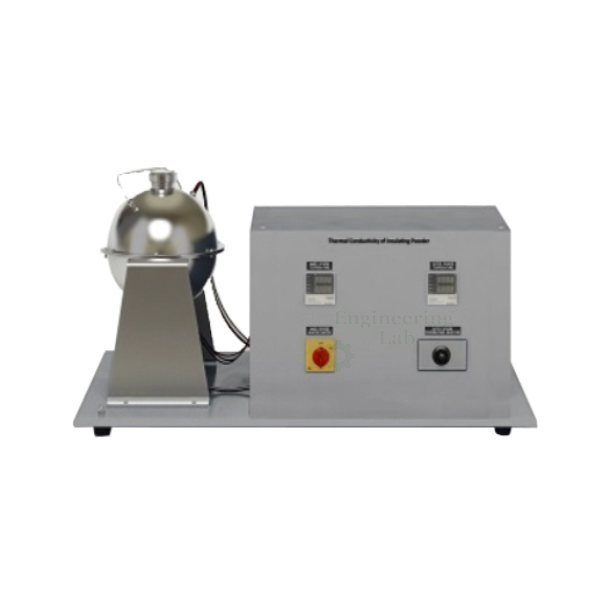
Product Code : EL-HAMTLE-10760
Computerized Thermal Conductivity of Powder (code EL-HAMTLE-10760) is a trainer in which insulating powder fills the space between two thin-walled concentric copper spheres, heated from within by a coil of nichrome wire on mica sheet, so that the thermal conductivity of the powder can be found. The spheres have radii of 50 mm and 100 mm, four thermocouples sit on the inner sphere and six on the outer, and heater power is set by a dimmer stat and measured with a voltmeter and an ammeter.
Get a quote: use the Add To Cart enquiry button below, or send your quantity and delivery location through the contact page.
Specifications
| Parameter | Detail |
|---|---|
| Use | Determining thermal conductivity of insulating powder at different temperatures |
| Construction | Two thin-wall concentric copper spheres, with the insulating powder packed between the shells |
| Inner sphere radius | 50 mm |
| Outer sphere radius | 100 mm |
| Insulating powder | Asbestos magnesia, commercially available, packed between the two spheres |
| Heating coil | Nichrome wire wound on mica sheet, housed in the inner sphere |
| Heater control | Power supplied through a dimmer stat; measured by voltmeter and ammeter |
| Thermocouples | Four on the inner sphere, six on the outer sphere |
| Temperature readout | Ten-temperature indicator |
| Instruments | Panel-mounted on a control panel |
| Instrumentation | Microprocessor-based, housed in the unit |
| Software functions | Educational software, data acquisition, system operation |
| Intended users | Institutions, research laboratories and insulating powder manufacturers |
| Heater, mica type | |
| Heating power | 350 W |
| Temperature limitation | 95 °C |
| Measuring ranges | |
| Temperature | 2 × 0–325 °C |
| Heating power | 0–450 W |
| Requirements, dimensions and weight | |
| Power supply | 230 V, 50 Hz, 1 phase; 230 V, 60 Hz, 1 phase; 120 V, 60 Hz, 1 phase |
| Dimensions (L × W × H) | Approx. 600 × 600 × 500 mm |
| Weight | Approx. 25 kg |
| Supply | |
| Product code | EL-HAMTLE-10760 |
| Manufacturer | Engineering Lab Equipment, Ambala, Haryana, India |
What Is the Computerized Thermal Conductivity of Powder Used For?
Insulating powders are judged by how little heat they let through. In the concentric sphere method, heat from the coil in the inner sphere can only escape outward through the powder layer to the outer sphere, so once temperatures are steady all the electrical power supplied passes through the powder. The operator sets the heater with the dimmer stat, reads voltage and current to find the power, and records the four inner and six outer thermocouple temperatures. With the two sphere radii and the mean temperature difference across the layer, the thermal conductivity of the powder is calculated, and repeating at other heater settings gives values at different temperatures.
What to Specify When Ordering
- Quantity — how many powder conductivity units are required.
- Supply — the single-phase version wanted, 230 V at 50 or 60 Hz, or 120 V at 60 Hz.
Frequently Asked Questions
How does the sphere method measure thermal conductivity?
Heat from the coil in the inner sphere flows outward through the powder to the outer sphere. At steady state, the heater power, the two sphere temperatures and the radii give the powder's conductivity.
What size are the copper spheres?
The inner copper sphere has a radius of 50 mm and the outer sphere a radius of 100 mm, and the insulating powder is packed into the space between them.
How is the heater power measured?
The heater is fed through a dimmer stat, and its power is measured with a voltmeter and an ammeter, over a heating power range of 0 to 450 W.
How many thermocouples are fitted?
Four thermocouples are embedded on the inner sphere and six on the outer sphere, giving the temperatures on both sides of the powder layer.
What heater is used?
A mica-type heater made of nichrome wire wound on mica sheet sits inside the inner sphere, rated at 350 W with a temperature limitation of 95 °C.
Who is the apparatus intended for?
It is meant for teaching institutions and research laboratories, and also for manufacturers of insulating powder who need the conductivity of their product.
OEM Manufacturer
Buyers of the Computerized Thermal Conductivity of Powder deal directly with its maker, Engineering Lab Equipment (Engineering Labs Equipment Pvt Ltd), whose works are at Plot No. 43, Industrial Park, Sector 2, Growth Center, Saha, District Ambala, Haryana, India. The company designs, makes and tests heat and mass transfer apparatus for conduction, convection, radiation and heat exchangers, supplies engineering colleges, polytechnics, technical training institutes and research laboratories in India and overseas, and builds to institution-specific requirements on request. Tender details are on the Tenders/OEM page.
Related Heat and Mass Transfer Equipment
- Computerized Thermal Conductivity of Liquid — annular gap trainer measuring heat conduction in water, oil, air or carbon dioxide.
- Guarded Hot Plate with Data Acquisition — bench-top guarded hot plate unit for thermal conductivity of non-metallic specimens, 500 W heaters.
- Free and Force Convection Apparatus — vertical air duct convection trainer with four heating elements, 500 m³/h fan and USB software.
See the full Heat and Mass Transfer Lab Equipment range or all Mechanical Engineering Lab Equipment.
Request a Quote
For this and other heat and mass transfer lab equipment, schools and colleges can contact Engineering Lab Equipment, a manufacturer, supplier and exporter based in Ambala, India. Quotations are given on request: send the number of units required and whether a 230 V or 120 V version is wanted and your delivery location through the contact page, or add the Computerized Thermal Conductivity of Powder to the enquiry cart from this page.
Last updated: October 2026