
Basic Refrigeration and Air Conditioning Training System
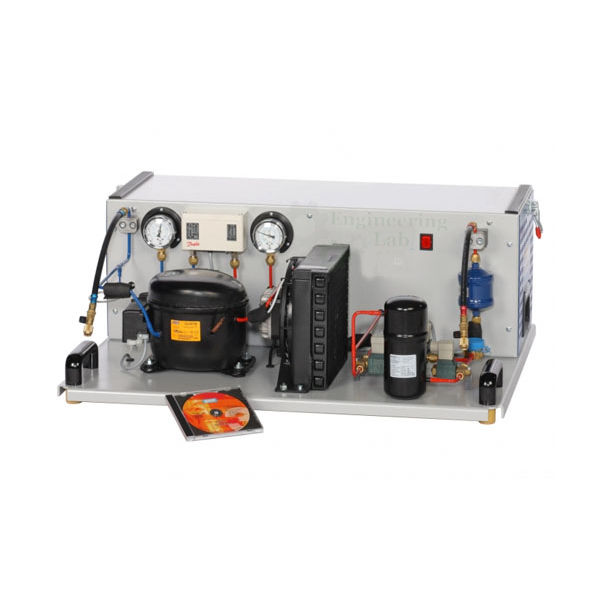
Product Code : EL-RAACLE-10784
Basic Refrigeration and Air Conditioning Training System (code EL-RAACLE-10784) is a refrigeration base unit on which basic experiments in refrigeration and air conditioning are set up, carrying a compressor, condenser and receiver with electrical and communication systems. Models plug onto it and connect through refrigerant hoses with self-sealing couplings and electrical cables; the condensing unit gives 340 W at 0/32 °C, and sensors feed temperatures and pressures to software on a PC over USB.
Get a quote: use the Add To Cart enquiry button below, or send your quantity and delivery location through the contact page.
Specifications
| Parameter | Detail |
|---|---|
| Purpose | Base unit for setting up basic experiments in refrigeration and air conditioning technology |
| Main components | Compressor, condenser and receiver, plus electrical and communications systems |
| Model connection | Models plugged onto the base unit; connected hydraulically with refrigerant hoses and electrically with cables |
| Couplings | Self-sealing, keeping refrigerant loss to a minimum |
| Layout | All components arranged in clear view so their operation can be monitored |
| Software | Hardware/software integration (HSI) for running and analysing experiments |
| Data acquisition | Temperatures and pressures recorded by sensors and displayed dynamically in the software |
| PC connection | USB interface |
| Condensing unit and refrigerant | |
| Refrigeration capacity | 340 W at 0/32 °C |
| Receiver | 0,7 L |
| Refrigerant | Currently available in the market |
| Filling volume | 700 g |
| CO2-equivalent | 0,4 t |
| Measuring ranges | |
| Temperature | 1 × -50 to 50 °C; 3 × 0 to 100 °C |
| Pressure, intake side | 1 × -1 to 9 bar |
| Pressure, delivery side | 2 × -1 to 15 bar |
| Learning content | |
| Refrigeration basics | Fundamentals of the refrigeration cycle |
| Air conditioning basics | Fundamentals of air conditioning |
| Components | Components in a refrigeration or air conditioning system |
| Operation | System operation |
| Diagnostics | Fault finding |
| Power, dimensions and weight | |
| Power supply | 230 V, 50 Hz, 1 phase; or 230 V, 60 Hz, 1 phase |
| Dimensions | Approx. 1100 × 800 × 1200 mm (L × W × H) |
| Weight | Approx. 115 kg |
| Supply | |
| Product code | EL-RAACLE-10784 |
| Manufacturer | Engineering Lab Equipment, Ambala, Haryana, India |
What Is the Basic Refrigeration and Air Conditioning Training System Used For?
The base unit is the common starting point for a series of introductory experiments: a refrigeration or air conditioning model is plugged on, joined by hoses and cables, and the complete circuit is then run and observed. Students trace the refrigerant through the compressor, condenser and receiver, watch how temperatures and pressures change as conditions are altered, and learn to recognise faults. The sensors pass these values to the HSI software over USB, where they are shown as the system runs and kept for analysis, while the self-sealing couplings let models be exchanged with little refrigerant loss.
What to Specify When Ordering
- Quantity — how many base units are needed.
- Mains frequency — whether the unit should be built for 230 V at 50 Hz or at 60 Hz, single phase.
Frequently Asked Questions
What is the base unit used for?
It is the base on which basic refrigeration and air conditioning experiments are set up, covering the refrigeration cycle, air conditioning fundamentals, components, system operation and fault finding.
How are models connected to the base unit?
Each model plugs onto the base unit and is linked by refrigerant hoses on the hydraulic side and by cables on the electrical side; self-sealing couplings keep refrigerant loss to a minimum.
How are measurements recorded?
Sensors record temperatures and pressures in the system, and the hardware/software integration displays them dynamically and handles data acquisition, with the unit linked to a PC by USB.
What are the measuring ranges?
Temperature is measured at one point from -50 to 50 °C and at three points from 0 to 100 °C; pressure at one intake point from -1 to 9 bar and at two delivery points from -1 to 15 bar.
What size is the condensing unit?
The condensing unit has a refrigeration capacity of 340 W at 0/32 °C, with a 0,7 L receiver and a 700 g refrigerant filling.
What floor space does it need?
Allow a footprint of about 1100 by 800 mm; the unit stands about 1200 mm high and weighs roughly 115 kg.
OEM Manufacturer
Buyers of the Basic Refrigeration and Air Conditioning Training System deal directly with its maker, Engineering Lab Equipment (Engineering Labs Equipment Pvt Ltd), whose works are at Plot No. 43, Industrial Park, Sector 2, Growth Center, Saha, District Ambala, Haryana, India. The company designs, makes and tests refrigeration and air conditioning trainers and test rigs, supplies engineering colleges, polytechnics, technical training institutes and research laboratories in India and overseas, and builds to institution-specific requirements on request. Tender details are on the Tenders/OEM page.
Related Refrigeration and Air Conditioning Equipment
- Air Conditioning System Trainer — air duct and climatic chamber trainer with condensing unit, steam humidifier, air heater and motorised flaps.
- Vapour Compression Refrigeration Trainer — refrigeration circuit trainer with glass evaporator and condenser, float valve and SES36 refrigerant.
- Gas Charging Trainer — bench unit with vacuum pump, 1000 g R134a filling cylinder and manometers for evacuation and charging practice.
- Refrigeration Assembly and Maintenance Accessories — workbench refrigeration assembly trainer with bolted pipe joints, condensing unit, show case evaporator and chamber.
See the full Refrigeration and Air Conditioning Lab Equipment range or all Mechanical Engineering Lab Equipment.
Request a Quote
For this and other refrigeration and air conditioning lab equipment, schools and colleges can contact Engineering Lab Equipment, a manufacturer, supplier and exporter based in Ambala, India. Quotations are given on request: send the number of base units and the mains frequency, 50 Hz or 60 Hz and your delivery location through the contact page, or add the Basic Refrigeration and Air Conditioning Training System to the enquiry cart from this page.
Last updated: October 2026


