
Computerized Reciprocating Pump Test Apparatus
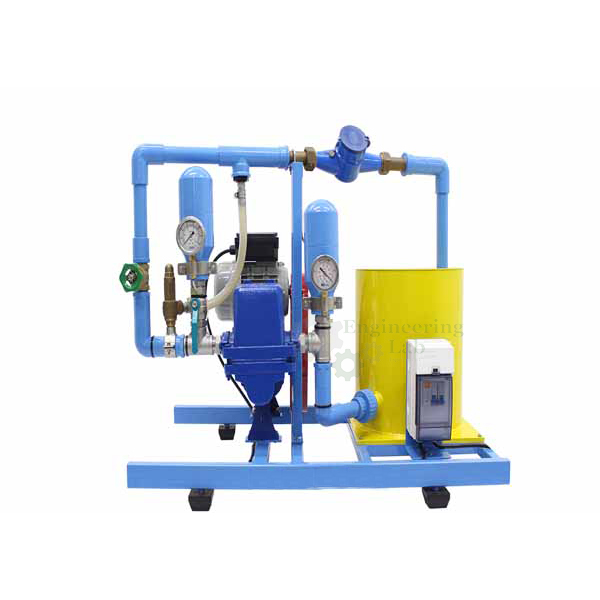
Product Code : EL-TMLE-10688
Computerized Reciprocating Pump Test Apparatus (code EL-TMLE-10688) is an experimental unit for demonstrating the operating behaviour and important characteristic variables of piston pumps. A piston pump with variable speed of 30–180 min-1 via frequency converter, delivering up to 135 L/h at a maximum head of 40 m, works in a closed water circuit with an air vessel, and its sensors send data via USB to a PC with the included software.
Get a quote: use the Add To Cart enquiry button below, or send your quantity and delivery location through the contact page.
Specifications
| Parameter | Detail |
|---|---|
| Water circuit | Closed: water tank, piston pump and air vessel |
| Pump drive | Variable speed via frequency converter |
| Piston housing | Transparent, so the piston can be observed in operation |
| Pulsation damping | Air vessel damps the pulsating pressure curve |
| Flow and head adjustment | Needle valve and overflow valve |
| Pressure sensors | At the pump outlet and inside the cylinder |
| Piston position | Angle sensor on the piston rod, for determining cylinder volume |
| Data acquisition | Microprocessor-based measuring technique in the housing; values sent via USB to a PC; software included |
| Experiments | Principle of operation of a piston pump, efficiencies, pump characteristics, delivery and cylinder pressure curves, influence of pulsation damping, p-V diagram |
| Gear transmission ratio | 1:7.5 |
| Piston pump | |
| Speed | 30–180 min-1 |
| Max. flow rate | 135 L/h |
| Max. head | 40 m |
| Drive motor | |
| Power | 180 W |
| Measuring ranges | |
| Pressure, cylinder | 0–5 bar |
| Pressure, outlet | 0–5 bar |
| Crank angle | 0–360° |
| Flow rate | 0.2–6 L/min |
| Supply and size | |
| Power supply | 230 V, 50 Hz, 1 phase |
| Alternative supplies | 230 V, 60 Hz, 1 phase; 120 V, 60 Hz, 1 phase |
| Dimensions | 670 × 590 × 740 mm (L × W × H) |
| Weight | Approx. 49 kg |
| Supply | |
| Product code | EL-TMLE-10688 |
| Manufacturer | Engineering Lab Equipment, Ambala, Haryana, India |
What Is the Computerized Reciprocating Pump Test Apparatus Used For?
A reciprocating pump draws water into its cylinder as the piston moves back and pushes it out as the piston moves forward, so the delivery pulsates with each stroke. Students run the pump at speeds from 30 to 180 min-1, set the flow and head with the needle valve and overflow valve, and watch the piston through the transparent housing while the cylinder and outlet pressures and the crank angle are recorded. The software draws the p-V diagram of the intake and discharge cycle, the delivery and cylinder pressure curves and the pump characteristics, and the influence of the air vessel on pulsation damping can be studied.
What to Specify When Ordering
- Quantity — the number of reciprocating pump units required.
- Power supply — 230 V, 50 Hz, 1 phase, or the 230 V, 60 Hz or 120 V, 60 Hz, 1 phase version.
Frequently Asked Questions
What is the p-V diagram used for here?
Pressure inside the cylinder is plotted against cylinder volume, found from the piston rod angle sensor, so the intake and discharge of water in each cycle can be seen clearly.
What are the pump and drive ratings?
The piston pump runs at 30–180 min-1 through a gear transmission ratio of 1:7.5 from a 180 W drive motor, with a maximum flow rate of 135 L/h and a maximum head of 40 m.
How is the pulsating delivery damped?
An air vessel in the circuit damps the pulsating pressure curve of the pump, and the influence of this pulsation damping is one of the experiments.
Which sensors are fitted?
One pressure sensor measures at the pump outlet and another inside the cylinder, both over 0–5 bar, and an angle sensor follows the piston rod over 0–360° of crank angle.
How is the data recorded?
Microprocessor-based measuring technique, protected in the housing, transmits the measured values directly via USB to a PC, where they are analysed with the included software.
Which supply versions exist?
The unit runs on 230 V, 50 Hz, 1 phase, and versions for 230 V, 60 Hz, 1 phase and 120 V, 60 Hz, 1 phase are also listed.
OEM Manufacturer
Buyers of the Computerized Reciprocating Pump Test Apparatus deal directly with its maker, Engineering Lab Equipment (Engineering Labs Equipment Pvt Ltd), whose works are at Plot No. 43, Industrial Park, Sector 2, Growth Center, Saha, District Ambala, Haryana, India. The company designs, makes and tests turbo machinery test rigs for pumps and turbines, supplies engineering colleges, polytechnics, technical training institutes and research laboratories in India and overseas, and builds to institution-specific requirements on request. Tender details are on the Tenders/OEM page.
Related Turbo Machinery Equipment
- Computerized Centrifugal Pump Trainer — closed circuit centrifugal pump trainer with variable speed drive, torque measurement and two flow measuring methods.
- Computerized Axial Flow Pump Test Rig — axial propeller pump trainer with closed circuit, 700 L/min pump and USB data acquisition.
- Submersible Pump Test Rig — closed circuit submersible pump rig with variable speed drive, gauges and volumetric flow tank.
- Computerized Hydraulic Ram — water hammer and hydraulic ram demonstrator with air vessel, transparent pump head and PC data logging.
See the full Turbo Machinery Lab Equipment range or all Mechanical Engineering Lab Equipment.
Request a Quote
For this and other turbo machinery lab equipment, schools and colleges can contact Engineering Lab Equipment, a manufacturer, supplier and exporter based in Ambala, India. Quotations are given on request: send the number of units and the power supply version required and your delivery location through the contact page, or add the Computerized Reciprocating Pump Test Apparatus to the enquiry cart from this page.
Last updated: October 2026


