
Computerized Thermal Conductivity of Liquid
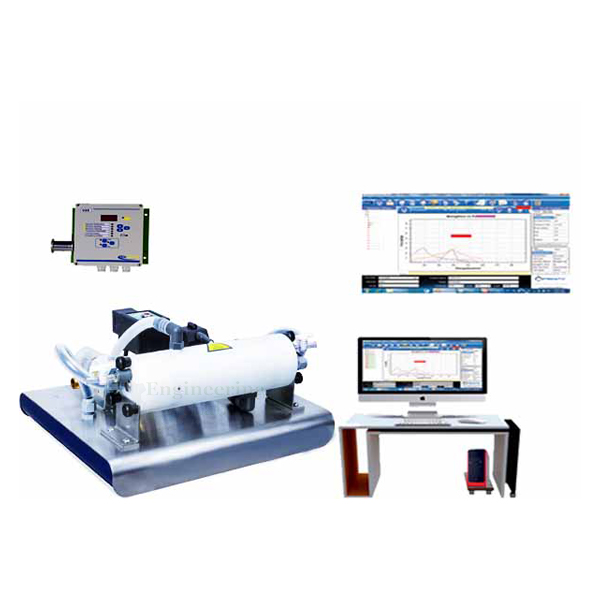
Product Code : EL-HAMTLE-10759
Computerized Thermal Conductivity of Liquid (code EL-HAMTLE-10759) is a trainer for heat conduction in fluids, in which an electrically heated inner cylinder sits inside a water-cooled outer cylinder and the fluid under test fills the narrow concentric annular gap between them. The gap is 0.4 mm high with an average diameter of 29.6 mm, the heater is rated at 350 W with a 95 °C temperature limit, and fluids such as water, oil, air or carbon dioxide can be tested.
Get a quote: use the Add To Cart enquiry button below, or send your quantity and delivery location through the contact page.
Specifications
| Parameter | Detail |
|---|---|
| Use | Steady and transient heat conduction in gases and liquids |
| Construction | Concentric annular gap between 2 cylinders containing the fluid being studied |
| Inner cylinder | Continuously electrically heated |
| Outer cylinder | Water-cooled |
| Fluids | For example water, oil, air or carbon dioxide |
| Gap function | Narrow gap prevents a convective heat flux, gives a relatively large pass-through area and a homogeneous temperature distribution |
| Temperature sensors | Inside and outside the annular gap |
| Experiments | Thermal resistance of fluids; thermal conductivities of different fluids at different temperatures; transient states during heating and cooling; block capacity model |
| Software functions | Educational software, data acquisition, system operation |
| Instrumentation | Microprocessor-based, housed in the unit |
| Specific heat capacity | 890 J/kg K |
| Heat transfer area | 0.007439 m² |
| Heater | |
| Heating power | 350 W |
| Temperature limitation | 95 °C |
| Annular gap | |
| Height | 0.4 mm |
| Average diameter | 29.6 mm |
| Inner cylinder | |
| Mass | 0.11 kg |
| Measuring ranges | |
| Temperature | 2 × 0–325 °C |
| Heating power | 0–450 W |
| Requirements, dimensions and weight | |
| Power supply | 230 V, 50 Hz, 1 phase; 230 V, 60 Hz, 1 phase; 120 V, 60 Hz, 1 phase |
| Dimensions (L × W × H) | Approx. 800 × 600 × 500 mm |
| Weight | Approx. 30 kg |
| Supply | |
| Product code | EL-HAMTLE-10759 |
| Manufacturer | Engineering Lab Equipment, Ambala, Haryana, India |
What Is the Computerized Thermal Conductivity of Liquid Used For?
Liquids and gases conduct heat far less than metals, and measuring their conductivity is difficult because convection currents carry heat as well. A very thin layer of fluid suppresses those currents, so the heat crossing it travels by conduction alone. Students fill the gap with water, oil, air or carbon dioxide, switch on the heater and wait until the temperatures inside and outside the gap are steady; the heating power, the gap height and the heat transfer area then give the thermal resistance and conductivity of the fluid. Repeating the test at other temperatures, and following heating and cooling curves with the block capacity model, covers the transient side.
What to Specify When Ordering
- Quantity — the number of liquid conductivity trainers required.
- Power supply — the single-phase supply on site: 230 V, 50 Hz, 230 V, 60 Hz or 120 V, 60 Hz.
Frequently Asked Questions
Why is the fluid held in a narrow annular gap?
A gap only 0.4 mm high stops convection currents from forming, so heat crosses the fluid by conduction alone, while the relatively large pass-through area keeps the temperature distribution even.
Which fluids can be tested?
Thermal conductivities can be determined for different fluids, for example water, oil, air or carbon dioxide, and at different temperatures.
What heater does the unit use?
The inner cylinder is heated continuously by an electric heater of 350 W with a temperature limitation of 95 °C; the heating power measuring range is 0 to 450 W.
Can transient heat conduction be studied?
Yes. Transient states during heating and cooling can be interpreted, and the experiments introduce transient heat conduction through the block capacity model.
What is the block capacity model?
It treats a body as having one uniform temperature that changes with time, so its heating or cooling can be calculated from its mass, specific heat capacity and the heat flowing in or out.
How are temperatures measured?
Temperature sensors sit inside and outside the annular gap, with a measuring range of 0 to 325 °C, and the software handles data acquisition and system operation.
OEM Manufacturer
Engineering Lab Equipment (Engineering Labs Equipment Pvt Ltd) builds the Computerized Thermal Conductivity of Liquid at its works in Saha, District Ambala, Haryana (Plot No. 43, Industrial Park, Sector 2, Growth Center). Its heat and mass transfer apparatus for conduction, convection, radiation and heat exchangers go to engineering colleges, polytechnics, technical training institutes and research laboratories in India and abroad, and equipment can be made to an institution's own requirements. For tenders and OEM supply, see the Tenders/OEM page.
Related Heat and Mass Transfer Equipment
- Computerized Thermal Conductivity of Powder — concentric copper sphere trainer for thermal conductivity of insulating powder, with ten thermocouples.
- Guarded Hot Plate with Data Acquisition — bench-top guarded hot plate unit for thermal conductivity of non-metallic specimens, 500 W heaters.
- Computerized Stefan Boltzman Apparatus — vacuum and pressure vessel trainer separating radiation and convection from a heated metal cylinder.
See the full Heat and Mass Transfer Lab Equipment range or all Mechanical Engineering Lab Equipment.
Request a Quote
For this and other heat and mass transfer lab equipment, schools and colleges can contact Engineering Lab Equipment, a manufacturer, supplier and exporter based in Ambala, India. For a price, send how many trainers you need and the single-phase supply available on site and the delivery location through the contact page; the Add To Cart button on this page also adds the Computerized Thermal Conductivity of Liquid to an enquiry.
Last updated: October 2026


