Free and Force Convection Apparatus
Product Code : EL-HAMTLE-10761
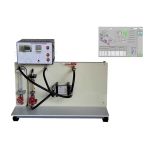
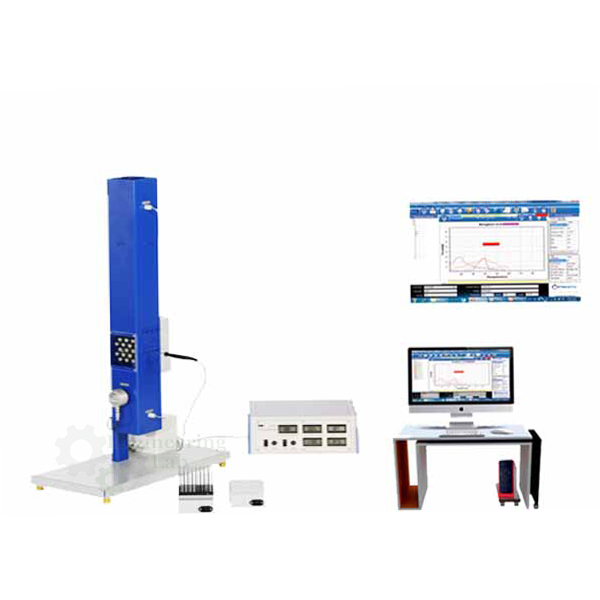
Free and Force Convection Apparatus (code EL-HAMTLE-10761) is a trainer for comparing free and forced convection on heating elements of different geometry inserted in a vertical air duct, through which an axial fan on top draws ambient air. Four heating elements are available, two of which can also be run outside the duct for free convection, and the 120 × 120 mm duct, a fan of up to 500 m³/h and USB-linked software allow Nusselt and Reynolds numbers to be determined.
Get a quote: use the Add To Cart enquiry button below, or send your quantity and delivery location through the contact page.
Specifications
| Parameter | Detail |
|---|---|
| Use | Basic experiments on free and forced convection on various heating elements |
| Air duct | Vertical, with heating elements inserted into it |
| Fan | Axial fan on top of the duct, drawing ambient air through it |
| Heating elements | Four, of different geometries; two can be operated outside the duct for free convection |
| Element design | Heat released only at the surface; compact, for rapid heating and short experiment times |
| Sensors | Temperature at the duct inlet and outlet; air velocity, to determine the airflow rate |
| Control | Heating power and flow rate adjusted and displayed via the software |
| PC connection | USB |
| Software functions | Educational software, data acquisition, system operation |
| Experiments | Nusselt number; free and forced convection; flow formation and heat transfer; transient heating process |
| Geometries | Flat plate, cylinder, tube bundle |
| Characteristic variables | Nusselt number, Reynolds number |
| Air duct | |
| Flow cross-section | 120 × 120 mm |
| Height | Approx. 0.6 m |
| Element temperature limitation | 90 °C |
| Tube bundle | |
| Number of tubes | 23 |
| Heated tube | One tube in variable position |
| Heating power | 20 W |
| Heat transfer area | 0.001 m² |
| Cylinder with even surface temperature | |
| Heating power | 20 W |
| Heat transfer area | 0.0112 m² |
| Plate | |
| Heating power | 40 W |
| Heat transfer area | 2 × 0.01 m² |
| Cylinder with heating foil, for local heat transfer | |
| Heating power | 40 W |
| Heat transfer area | 0.0112 m² |
| Axial fan | |
| Max. flow rate | 500 m³/h |
| Max. pressure difference | Approx. 950 Pa |
| Power consumption | 90 W |
| Measuring ranges | |
| Air velocity | 0–10 m/s |
| Temperature | 4 × 0–325 °C |
| Heating power | 0–50 W |
| Requirements, dimensions and weight | |
| Power supply | 230 V, 50 Hz, 1 phase; 230 V, 60 Hz, 1 phase; 120 V, 60 Hz, 1 phase |
| Dimensions (L × W × H) | Approx. 800 × 600 × 800 mm |
| Weight | Approx. 30 kg |
| Supply | |
| Product code | EL-HAMTLE-10761 |
| Manufacturer | Engineering Lab Equipment, Ambala, Haryana, India |
What Is the Free and Force Convection Apparatus Used For?
Convection is heat carried away from a surface by a moving fluid. In free convection the air moves only because it rises as it warms; in forced convection a fan drives it past the surface. Students choose a flat plate, cylinder or tube bundle element, fit it in the duct, and set the heating power and fan flow in the software, reading inlet and outlet air temperatures and air velocity. Running one of the two outside elements with no airflow gives the free convection case. The heating-foil cylinder shows how heat transfer varies around its surface, and moving the heated tube within the 23-tube bundle shows the effect of its position.
What to Specify When Ordering
- Quantity — the number of convection apparatus sets required.
- Supply rating — single-phase 230 V, 50 Hz, 230 V, 60 Hz or 120 V, 60 Hz.
Frequently Asked Questions
What is the difference between free and forced convection?
In free convection, air moves only because it rises as it is warmed; in forced convection, a fan drives the air past the surface, which generally increases heat transfer.
Which heating elements are available?
Four elements are available: a tube bundle of 23 tubes with one heated tube in variable position, a cylinder with an even surface temperature, a flat plate, and a cylinder with heating foil for local heat transfer.
Can free convection be tested outside the duct?
Yes. Two of the four heating elements can be operated outside the air duct, so free convection can be studied without the fan-driven airflow.
What does the axial fan deliver?
The axial fan on top of the 120 × 120 mm duct gives a maximum flow rate of 500 m³/h and a pressure difference of approx. 950 Pa, drawing 90 W.
What do the Nusselt and Reynolds numbers describe?
The Nusselt number compares heat transferred by convection with that by conduction alone, and the Reynolds number characterises the flow, indicating whether it is laminar or turbulent.
How is an order placed for this apparatus?
Click the Add To Cart enquiry button on this page, or use the contact page to send the number of units needed and where they are to be delivered.
OEM Manufacturer
The Free and Force Convection Apparatus is made by Engineering Lab Equipment (Engineering Labs Equipment Pvt Ltd) at its works at Plot No. 43, Industrial Park, Sector 2, Growth Center, Saha, District Ambala, Haryana, India. The company designs, makes and tests heat and mass transfer apparatus for conduction, convection, radiation and heat exchangers for engineering colleges, polytechnics, technical training institutes and research laboratories in India and overseas, and can build equipment to an institution's own requirements. Tender and OEM enquiries are handled through the Tenders/OEM page.
Related Heat and Mass Transfer Equipment
- Computerized Boiling Heat Transfer Apparatus — fire tube boiling trainer with transparent 10 L tank, 250 W heater and USB data logging.
- Computerized Steady State & Non Steady Heat Transfer — steady and transient conduction trainer for 40 mm metal samples with 12 thermocouples each.
- Computerized Thermal Conductivity of Powder — concentric copper sphere trainer for thermal conductivity of insulating powder, with ten thermocouples.
See the full Heat and Mass Transfer Lab Equipment range or all Mechanical Engineering Lab Equipment.
Request a Quote
For this and other heat and mass transfer lab equipment, schools and colleges can contact Engineering Lab Equipment, a manufacturer, supplier and exporter based in Ambala, India. To ask for a quotation, send the number of apparatus sets and the supply voltage and frequency on site and your delivery location through the contact page, or use the Add To Cart enquiry button on this page.
Last updated: October 2026