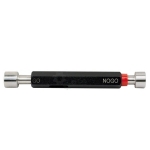
Telescopic Feeler Gauge

Product Code : EL-MAILE-10830
Telescopic Feeler Gauge (code EL-MAILE-10830) is a telescoping gauge used to take internal sizes, such as the diameter of a bore or bearing seat or the width of a groove, for measurement with a micrometer. It covers 2-1/4 to 3-1/2 inch, has two spring-expanded feelers with hardened measuring faces, a knurled clamp on the handle and a satin chrome finish, and comes in a fitted plastic pouch.
Get a quote: use the Add To Cart enquiry button below, or send your quantity and delivery location through the contact page.
Specifications
| Parameter | Detail |
|---|---|
| Measuring range | 2-1/4 to 3-1/2 in |
| Use | Internal measurements such as bores and bearing seats; finding internal diameter or groove width |
| Feelers | Two, expanded by pressure springs (spring-loaded plunger) |
| Measuring faces | Hardened |
| Clamp | Knurled clamp; knurled handle clamp rod |
| Finish | Satin chrome |
| Measurement transfer | Actual size taken across both ends of the feelers with a micrometer |
| Supplied in | Fitted plastic pouch |
| Product code | EL-MAILE-10830 |
| Manufacturer | Engineering Lab Equipment, Ambala, Haryana, India |
What Is the Telescopic Feeler Gauge Used For?
A telescoping gauge has no scale of its own; it transfers an internal size to an outside micrometer, which then gives the reading. The user compresses the feelers, inserts them into the bore or groove and releases them so the springs push them out against the walls, rocks the gauge gently to find the true diameter, and locks the feelers with the knurled clamp. After withdrawal, the distance across both ends of the feelers is measured with a micrometer. It is used in workshops for checking bores and bearing seats.
What to Specify When Ordering
- Quantity — the number of telescoping gauges required.
Frequently Asked Questions
What size range does the gauge cover?
This gauge has a measuring range of 2-1/4 to 3-1/2 inch, for bores, grooves and bearing seats within that span.
How is the reading taken?
The gauge does not read directly. After the feelers have been locked to the bore size, the distance across both ends is measured with a micrometer.
How do the feelers expand?
The two feelers are expanded by pressure springs, so they open out against the walls of the bore or groove until they are locked with the knurled clamp.
What finish and storage does it have?
The gauge is satin chrome finished, the clamp rod in its handle is knurled, and it is supplied in a fitted plastic pouch for storage.
Are the measuring faces hardened?
Yes. The measuring faces at the ends of the two feelers are hardened, since these are the surfaces that contact the bore walls.
OEM Manufacturer
The Telescopic Feeler Gauge is made by Engineering Lab Equipment (Engineering Labs Equipment Pvt Ltd) at its works at Plot No. 43, Industrial Park, Sector 2, Growth Center, Saha, District Ambala, Haryana, India. The company designs, makes and tests measuring instruments and instrumentation trainers for engineering laboratories for engineering colleges, polytechnics, technical training institutes and research laboratories in India and overseas, and can build equipment to an institution's own requirements. Tender and OEM enquiries are handled through the Tenders/OEM page.
Related Measuring Instruments
- Digital Bore Gauge — absolute encoder electronic gauge for 36–150 mm bores up to 10 in deep, with IP54 protection.
- Dial Bore Gauge — set of three dial-indicating gauges for 10 to 150 mm bores, carbide-tipped anvils, wooden case.
- Digital Thickness Gauge — 0 to 10 mm spindle thickness gauge with 0.01 mm LCD, ceramic contacts and reversible anvil.
See the full Measurement and Instrumentation Lab Equipment range or all Mechanical Engineering Lab Equipment.
Request a Quote
For this and other measurement and instrumentation lab equipment, schools and colleges can contact Engineering Lab Equipment, a manufacturer, supplier and exporter based in Ambala, India. To ask for a quotation, send the number of telescoping gauges required and your delivery location through the contact page, or use the Add To Cart enquiry button on this page.
Last updated: October 2026