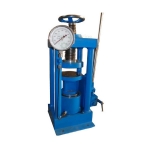
Jolting Apparatus

Product Code : EL-CTLE-10332
Jolting Apparatus (code EL-CTLE-10332) is a motor-driven table that compacts specimens in a mould clamped to it by repeatedly lifting the table and letting it fall freely onto a stop. A cam turning at 60 Rev/Min raises the table, a stroke counter with micro-switch halts the machine after 60 jolts, and the unit runs on a 230 V single phase A.C. supply and is supplied complete with mould and hopper.
Get a quote: use the Add To Cart enquiry button below, or send your quantity and delivery location through the contact page.
Specifications
| Parameter | Detail |
|---|---|
| Table | Rectangular, rigidly connected by two support arms to a spindle |
| Spindle position | 800 mm horizontal distance from the centre of the table |
| Lug and stop | Projecting lug with a plane face on the table, with a stop having a rounded upper surface beneath it |
| Drive | Cam connected to a motor and gearbox through a V-belt and pulleys; raises the table and lets it fall freely on the stop |
| Cam speed | 60 Rev/Min |
| Jolt counter | Stroke counter with micro-switch; stops the machine after 60 jolts |
| Mould mounting | Mould surmounted by the hopper, clamped rigidly to the table; locating pins for the mould compartments |
| Power supply | 230 V, single phase, A.C. |
| Supplied with | Mould and hopper |
| Optional | Digital preset counter, at extra cost |
| Standards | IS 1727 1967, IS 4031 1968, ASTM C 394, C 64 |
| Spares and accessories | |
| Steel mould | With base plate; three compartments, each 40 × 40 × 160 mm internal dimensions |
| De-moulding | Apparatus for de-moulding the specimen |
| Supply | |
| Product code | EL-CTLE-10332 |
| Manufacturer | Engineering Lab Equipment, Ambala, Haryana, India |
What Is the Jolting Apparatus Used For?
Cement strength is commonly found by testing prisms of a standard mortar, and each prism has to be compacted in the same way for results to be comparable. The three-compartment steel mould, with the hopper on top, is clamped to the table and filled with mortar; the cam then lifts the table and drops it onto the stop, and the stroke counter ends the run after 60 jolts, so every batch receives the same compaction. The prisms are later removed with the de-moulding apparatus, cured and tested. The standards listed are IS 1727 1967, IS 4031 1968, ASTM C 394 and C 64.
What to Specify When Ordering
- Quantity — the number of jolting apparatus required.
- Counter — whether the digital preset counter, supplied at extra cost, is wanted.
- Spares — any extra three-compartment steel moulds with base plate (40 × 40 × 160 mm) and the apparatus for de-moulding the specimen.
Frequently Asked Questions
How does the jolting action work?
A motor and gearbox drive a cam through a V-belt and pulleys. The cam raises the table, which then falls freely so that its lug strikes a stop with a rounded upper surface.
How many jolts does it give, and how is the run stopped?
The cam rotates at 60 Rev/Min, and a stroke counter fitted with a micro-switch stops the machine automatically once 60 jolts have been applied.
What mould is used with it?
The spares list includes a steel mould with base plate having three compartments, each 40 × 40 × 160 mm internally; locating pins hold the compartments, and the mould and hopper clamp to the table.
What power supply does it need?
It is suitable for operation on a 230 Volts, single phase, A.C. supply, with the motor driving the cam through a gearbox, V-belt and pulleys.
Is a digital counter available?
Yes. A Digital Preset Counter can be supplied at an extra cost, in addition to the standard stroke counter with micro-switch.
Which standards are listed for the apparatus?
The standards listed are IS 1727 1967, IS 4031 1968, ASTM C 394 and C 64, and an apparatus for de-moulding the specimens is offered among the accessories.
OEM Manufacturer
The Jolting Apparatus is made by Engineering Lab Equipment (Engineering Labs Equipment Pvt Ltd) at its works at Plot No. 43, Industrial Park, Sector 2, Growth Center, Saha, District Ambala, Haryana, India. The company designs, makes and tests concrete testing equipment, from workability apparatus and specimen moulds to compression and flexure machines for engineering colleges, polytechnics, technical training institutes and research laboratories in India and overseas, and can build equipment to an institution's own requirements. Tender and OEM enquiries are handled through the Tenders/OEM page.
Related Concrete Testing Equipment
- Mortar Penetrometer — spring penetrometer graduated 0–70 kg with 6 needles for the hardening rate of sieved mortar.
- Compression Testing Machine Hand Operated — hand-operated C channel load frame with self-aligning upper platen, offered from 50 kN to 3000 kN.
- Hydraulic Jacks — manually pumped loading jacks with 50 mm piston travel, bourdon tube gauge and flexible hose.
- Compaction Factor Test Apparatus — twin conical hopper and cylinder set on a steel frame for compacting factor tests on concrete.
- Beam Mould — 100 × 100 × 500 mm concrete beam mould of 4 plates with base plate.
See the full Concrete Testing Lab Equipment range or all Civil Engineering Lab Equipment.
Request a Quote
For this and other concrete testing lab equipment, schools and colleges can contact Engineering Lab Equipment, a manufacturer, supplier and exporter based in Ambala, India. To ask for a quotation, send the number of machines and whether the digital preset counter and spare moulds are required and your delivery location through the contact page, or use the Add To Cart enquiry button on this page.
Last updated: October 2026